MealMap — AI-Assisted UX Research
AI-Assisted UX Research

Project overview
MealMap is a UX research concept exploring how busy households decide what to eat, coordinate different preferences and make better use of the food they already have.
The project demonstrates how AI can support the administrative side of qualitative research—organising notes, identifying possible relationships and retrieving evidence—while leaving interpretation, validation and product decisions with the researcher.
The final experience presents the complete research journey across four connected views: an overview, research plan, AI-assisted synthesis and prioritised product recommendations.
The challenge
Meal planning appears simple, but it involves a recurring set of decisions about time, appetite, ingredients, dietary requirements, budgets and household availability.
Existing meal-planning tools often begin with an empty weekly calendar or a large recipe library. This places the burden of narrowing the options back onto the user. They may have plenty of inspiration but still lack a quick way to decide what is appropriate tonight.
Planning is also rarely an individual task. One person may carry most of the mental workload while preferences, schedule changes and last-minute requests arrive through scattered conversations and messages.
The research therefore focused on a broader question:
How might meal planning feel lighter, more collaborative and easier to adapt when everyday circumstances change?
Research objectives
The study was structured around four objectives:
Understand what triggers people to begin planning meals.
Identify where preferences, schedules and ingredients create friction.
Explore how planning responsibilities are shared across a household.
Discover how people respond when an existing meal plan becomes impractical.
Rather than beginning with a predetermined list of features, the project started with behaviour. This created space to understand the underlying job people were trying to complete before considering a digital solution.
Research methodology
The demonstration study used eight fictional participant profiles representing a range of household and planning situations:
Solo professional
Young family
Shared household
Confident cook
Routine planner
Person with dietary constraints
Budget-focused shopper
Low-confidence cook
The proposed method mix included:
Six semi-structured interviews
Two three-day diary studies
One collaborative synthesis workshop
136 individual research notes
Interview and diary observations were converted into concise, atomic notes. These could then be compared without losing their connection to the original participant, activity or source.
All participant identities, quotations and study data used in this portfolio concept are fictional demonstration content.

Responsible use of AI
AI was used as a research assistant rather than an autonomous decision-maker.
Its role was limited to suggesting labels, highlighting similarities, identifying possible clusters and accelerating evidence retrieval. Every suggested relationship was reviewed by the researcher before becoming part of the final synthesis.
The workflow followed four stages:
1. Capture
Interview and diary-study observations were recorded as individual research notes, with enough context to understand their source.
2. Structure
AI suggested descriptive labels and possible relationships across the dataset. These suggestions were treated as starting points rather than confirmed insights.
3. Validate
Candidate themes were checked against the source notes, participant coverage and contradictory evidence. Weak or overly general clusters were rejected or reframed.
4. Translate
Validated needs were converted into product opportunities, design principles and testable recommendations.
Additional safeguards included data minimisation, de-identification, traceable source references, human review and the retention of evidence that did not fit the dominant pattern.
Research synthesis
The synthesis produced four connected themes.
Decision load
Participants repeatedly encountered every constraint at once: available time, appetite, dietary requirements, household preferences and existing ingredients.
The difficulty was not finding more recipes. It was narrowing the possibilities quickly enough to make a decision.
Evidence: 38 notes across seven of eight participant profiles.
Food visibility
People frequently discovered useful ingredients only after they had already begun planning—or when those ingredients were close to being wasted.
A visible inventory alone was not enough. Ingredients needed to be connected to realistic meal possibilities.
Evidence: 31 notes across six of eight profiles.
Shared planning
Meal plans often existed primarily in one person’s head. Other household members contributed preferences or objections, but rarely shared the complete planning task.
This created an uneven mental workload and made late changes more disruptive.
Evidence: 35 notes across seven of eight profiles.
Flexibility
Participants expected plans to change. The problem was that many planning tools treated deviation as failure rather than a normal part of household life.
Users needed an easy escape route when time, appetite or availability changed.
Evidence: 32 notes across six of eight profiles.

Product recommendations
The findings were translated into four product opportunities. Each recommendation was considered against user value, supporting evidence and the likely effort required to test it.
1. Start with tonight, then build the week
Replace the empty weekly calendar with a guided first decision based on available time, appetite and household availability.
Once tonight’s meal is agreed, MealMap can use it as the starting point for the rest of the week.
Design principle: Reduce choices before showing recipes.
2. Make ingredients useful, not merely visible
Ask users to identify a small number of ingredients they want to use soon. MealMap can then suggest appropriate meals and substitutions around those ingredients.
This avoids the burden of creating and maintaining a complete digital inventory.
Design principle: Ask for a few useful ingredients, not a full stock count.
3. Share preferences before sharing a finished plan
Allow household members to contribute availability, dislikes, dietary requirements and simple meal preferences before one person creates the final plan.
This distributes input without requiring every person to become a full planner.
Design principle: Make contribution lightweight and planning responsibility visible.
4. Help the plan recover when life changes
Provide a clear method for replacing, postponing or simplifying a meal while preserving ingredients and useful parts of the existing plan.
Design principle: Treat adaptation as a core workflow, not an error state.
Interface design
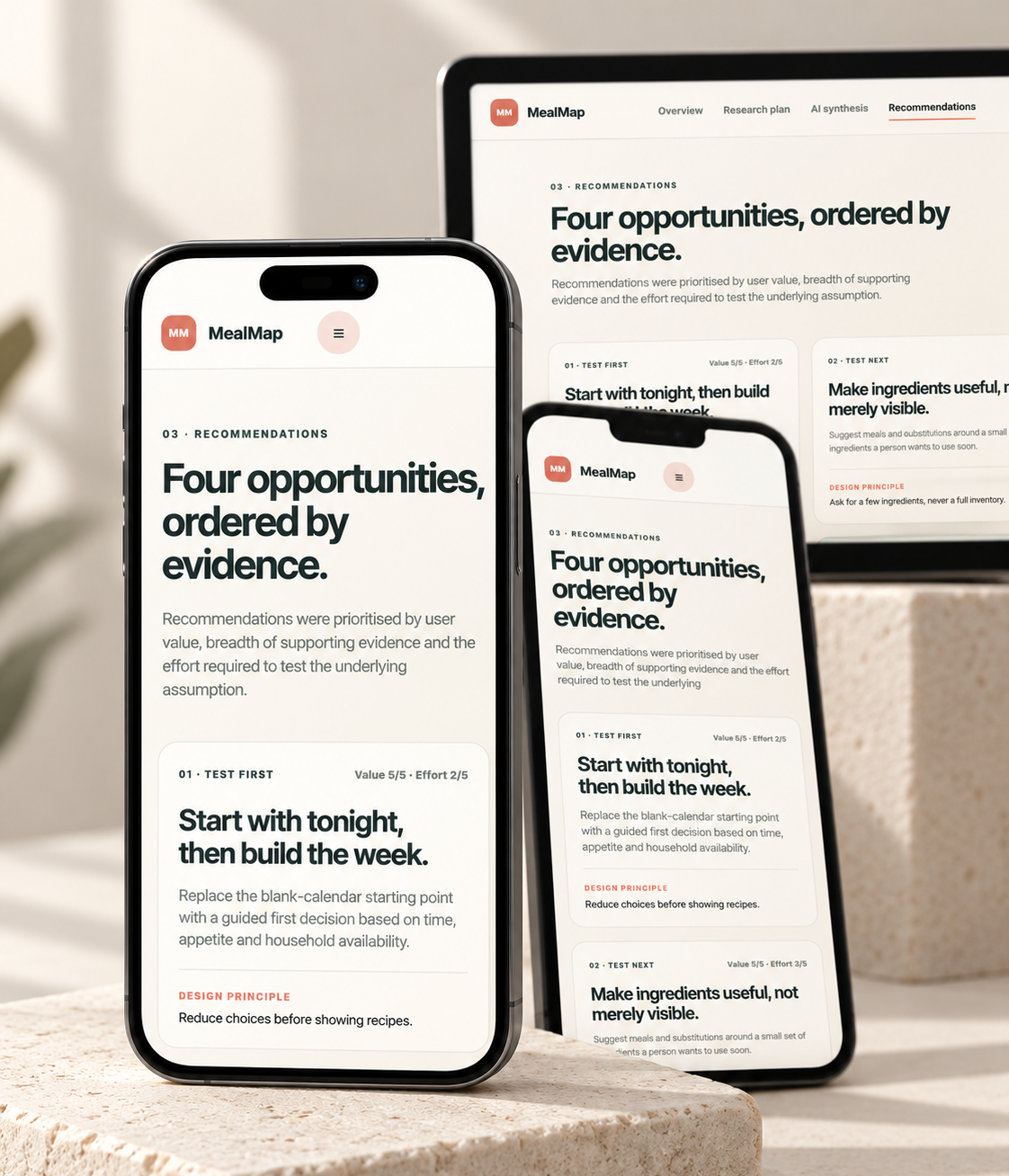
The research was presented as a responsive four-page experience:
Overview
Introduces the research problem, study scale, emerging themes and the relationship between evidence and product direction.
Research plan
Explains the objectives, participant profiles, proposed methodology and safeguards used when applying AI to qualitative data.
AI-assisted synthesis
Presents the evidence board, theme confidence, participant coverage and representative research notes. Filter controls allow themes to be reviewed individually.
Recommendations
Connects validated findings to four prioritised product opportunities and the design principles behind them.
The interface uses a calm editorial system with warm cream surfaces, dark forest-green typography, coral accents and muted gold highlights. Large headings establish a clear narrative while cards and supporting labels make the research evidence easy to scan.
The responsive layouts were designed to preserve the same research hierarchy on desktop, tablet and mobile screens.
Outcome
MealMap demonstrates a clear line of sight from research question to product direction.
The project delivers:
A structured research plan
A transparent approach to AI-assisted synthesis
Four traceable research themes
Four evidence-based product opportunities
A responsive case-study website
A deployed experience suitable for a UX portfolio
The result is not presented as a validated commercial product. It is a portfolio demonstration of how responsible AI assistance, qualitative research and product thinking can work together without obscuring the researcher’s judgement.
Recommended next steps
The next phase would test the strongest recommendation—starting with tonight rather than an empty weekly calendar—through a lightweight interactive prototype.
Five to eight moderated usability sessions could then assess:
Whether the guided starting point reduces decision time
Which household constraints should be requested first
How much ingredient information users are willing to provide
Whether preference sharing feels collaborative rather than demanding
How users expect the system to respond when plans change
These sessions would provide the evidence needed to refine the concept before progressing to a working MealMap product.